Why Your Packaging Quotes Are Not Comparable.
Updated: Sep 24

Two quotes can look like they’re for exactly the same packaging and still be based on very different specifications. Learn what could be hiding behind the numbers and how to compare supplier quotations more confidently.
You have sent the same packaging brief to three suppliers.
Three quotations arrive.
One is significantly cheaper. One includes several lines you do not recognise. Another provides a single price with very little explanation.
At first glance, it seems simple: compare the unit prices and choose the best value.
But packaging quotations are rarely like-for-like even when every supplier has received the same brief.
Each manufacturer may have interpreted your requirements differently, selected different materials or constructions, included different services, and made different assumptions about production, delivery and quality.
The lowest figure may not represent the lowest final cost. And the most expensive quotation may include important elements that have been left out elsewhere.
Before choosing a supplier, you need to understand what you are actually comparing.

A quotation is only as accurate as the brief behind it
A supplier can only quote accurately when the packaging requirements have been clearly defined.
If your request simply asks for “a luxury rigid box with a magnetic closure”, the manufacturer must fill in the gaps.
They may make assumptions about:
The finished dimensions
Board thickness
Type and weight of wrapping paper
The number and strength of the magnets
The printing process
The internal fitment
The level of hand-finishing required
Quantity and delivery arrangement
Different suppliers will make different assumptions and those decisions will affect the price.
One manufacturer might quote a substantial, paper-wrapped rigid box with concealed magnets and a bespoke fitment. Another might quote a lighter board, standard paper and an empty box.
Both may technically meet the original description, but they are not quoting the same product.
The clearer your specification, the more meaningful your quotations become.

Materials that look similar may perform very differently
Material choices are one of the most common reasons for variation between packaging quotations.
A quote might refer broadly to “greyboard”, “uncoated paper” or “recycled card”, without defining the exact grade, thickness, weight, finish or manufacturer.
Those details matter.
Two boards of the same stated thickness can differ in rigidity, density, flatness and recycled content. Two uncoated papers can behave very differently when printed, folded or wrapped. A colour shown on screen may require a standard stock, a dyed-through paper or a fully printed sheet each carrying a different cost and visual result.
For a rigid box, check whether the quotation confirms:
The board thickness or calliper
The grade and composition of the board
The wrapping paper specification
Whether the paper is standard, specialist or custom-made
The internal and external covering materials
The material used for any fitment or insert
If one supplier has specified premium materials and another has used economical alternatives, their unit prices cannot be fairly compared without acknowledging that difference.
The construction may not be the same
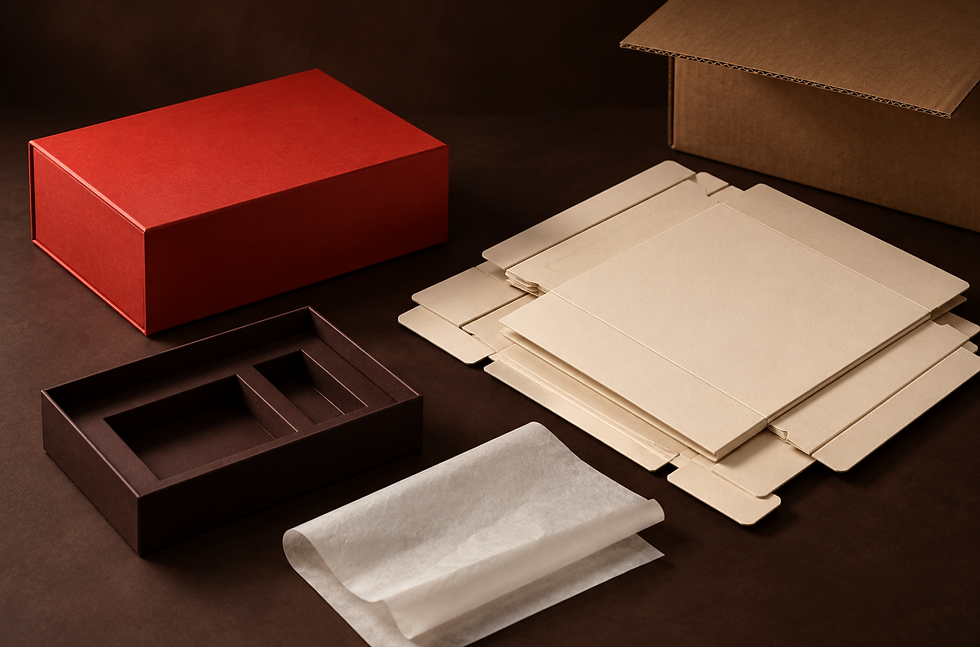
Packaging descriptions can hide considerable structural variation.
A “shoulder box”, for example, might have a visible or concealed shoulder. A presentation box could use a lift-off lid, hinged lid, book-style opening or magnetic flap. Even a standard tray-and-lid box can vary in board thickness, lid depth, tolerances and assembly method.
The internal fitment may also differ.
One supplier might propose folded board. Another may use foam, moulded pulp, vac-formed plastic or a paper-engineered structure. Each option affects presentation, protection, sustainability, tooling and assembly.
Before comparing costs, confirm that each quotation is based on the same:
Packaging style
Dimensions
Opening experience
Board construction
Fitment material
Product orientation
Assembly requirements
A small structural difference can have a significant effect on both cost and performance.

Print and finishing descriptions can be misleading
Special finishes are another area where quotations can appear similar while covering different processes.
Terms such as 'foil', 'emboss', 'spot gloss' or 'printed colour' do not always tell you enough.
A foil detail could involve different foil grades, coverage areas and application methods. An embossed logo may be produced using a single-level die or a more complex sculptured die. A metallic effect could be created using hot foil, metallic ink or a metallised material - all of which produce different results.
The number of print colours also matters. A supplier may have quoted one spot colour, while another has allowed for four-colour process printing. One may include printing on the inside of the box; another may not.
Check that every quotation clearly identifies:
The printing process
The number of colours
Whether colours are standard, Pantone-matched or custom
The location and coverage of the print
The finishing process
The size and position of each finish
Whether specialist dies, screens or plates are required
The phrase “Gold logo” is not a full specification. The intended process and finish must be defined.
Tooling may be included or charged separately

Many packaging projects require one-off tooling. Depending on the format, this might include:
Cutting formes
Foil-blocking dies
Embossing or debossing dies
Moulds
Screens
Printing plates
Sample-making charges
One supplier may include these costs within the quotation. Another may list them separately. A third may exclude them until artwork and structural drawings have been approved.
Tooling can materially change the initial project cost, particularly for a short production run.
You should also establish who owns the tooling, how long it will be retained and whether it can be reused for future orders. A lower first quotation may become more expensive if new tooling must be purchased every time you reorder.
Sampling is not always included
A plain structural sample, a digitally printed mock-up and a fully finished pre-production sample are not the same thing.
They serve different purposes and carry different costs.
Some quotations include a single plain sample. Others may include several development rounds or a finished prototype using production materials. Some suppliers deduct sampling charges from the final order, while others charge separately throughout development.
Confirm:
What type of sample is included
Which materials and finishes it will use
Whether delivery is included
How many revision rounds are allowed
Whether changes will be charged separately
Whether a pre-production sample is required before manufacture
Sampling is an important part of managing risk. It should not be treated as an optional extra without understanding the consequences.
The quantity may be calculated differently
Always check that suppliers are quoting the same production quantity.
Packaging is commonly produced with an agreed tolerance, meaning the final quantity delivered may be slightly higher or lower than the order quantity. Some manufacturers invoice the exact quantity produced; others charge against the original order.
A quotation for 1,000 units may also be calculated differently from a quote for “1,000 plus overs”. Suppliers may include additional components to account for spoilage, damage or packing requirements.
Ask whether the quotation includes:
The exact order quantity
Any permitted overrun or underrun
Production waste
Spare components
Minimum order requirements
Split deliveries or storage
It is also useful to request pricing at more than one volume. Comparing 500, 1,000 and 2,500 units can help you understand where the genuine economies of scale begin but only if every price is based on the same specification.
Assembly and packing can change the real cost
A low unit price may relate to packaging supplied flat, unassembled or in separate components.
That may be perfectly appropriate if your fulfilment partner is equipped to assemble it. If not, the saving can quickly disappear once you account for labour, storage, packing space and potential errors.
Clarify whether the packaging will arrive:
Fully assembled
Flat-packed
With fitments already inserted
With ribbons, magnets or accessories attached
Individually protected
Packed into export cartons
Palletised and ready for delivery
If assembly is not included, calculate where and how it will take place before comparing the final costs.
Delivery, duty and taxes can distort the headline price
One quote may include delivery to your warehouse. Another may cover production only.
For overseas manufacture, the quotation may exclude freight, insurance, import duty, customs clearance, port charges and final delivery. Currency fluctuations may also affect the amount you eventually pay.
Check the agreed Incoterm the commercial term that defines where responsibility and cost transfer from the supplier to the buyer.
You do not need to become a freight expert, but you do need to know whether the quotation is:
Ex-works from the factory
Delivered to a port
Inclusive of freight
Inclusive of duty and customs clearance
Delivered to your final UK address
A seemingly inexpensive overseas quotation can change considerably once the full landed cost is calculated.
VAT should also be compared consistently. Make sure you know whether it has been included or excluded from every figure.
Lead times may be based on different starting points
A quotation that promises a four-week lead time may sound faster than one stating six weeks but when does the clock begin?
It could start from:
Receipt of the purchase order
Payment of the deposit
Approval of the structural sample
Approval of the artwork
Approval of the pre-production sample
Receipt of all materials
The quoted lead time may cover production only, with sampling, shipping and customs clearance added separately.
Ask each supplier to provide a complete schedule showing development, material ordering, sampling, approvals, production, quality checks and delivery.
This is especially important when packaging is tied to a product launch, event or seasonal deadline.
Quality control is part of the price
Not every supplier will allow for the same level of quality assurance.
A robust quotation may include material testing, colour standards, production checks, inspection reports and agreed tolerances. A cheaper quote may provide little information about how quality will be assessed.
Before placing an order, define what will be checked and what constitutes an acceptable result.
This could include:
Finished dimensions
Colour variation
Print registration
Foil or emboss positioning
Glue marks
Scuffs or surface damage
Fitment performance
Closure strength
Acceptable quantity tolerances
The goal is not to demand perfection from a manufacturing process. It is to agree what acceptable quality looks like before production begins.
Payment terms affect the commercial comparison
Two quotes with the same total value may place very different demands on your cash flow.
One supplier might request full payment before production. Another may ask for a deposit followed by the balance before dispatch. Established clients may be offered credit terms.
Check:
The deposit required
When the remaining balance is due
The currency of payment
Whether exchange rates are fixed
Whether sampling and tooling are invoiced separately
What happens if the project is delayed or cancelled
Payment terms should be considered alongside the unit price, particularly when placing a large order or working with a new supplier.
How to compare packaging quotations properly

The safest approach is to create a comparison based on the complete project—not simply the price per box.
Review each quotation against the same headings:
Specification - Are the dimensions, structure, materials, print and finishes identical?
Development - What sampling, artwork support and revision rounds are included?
Tooling - Which one-off charges apply, and who owns the tooling?
Production - What quantity, tolerance, assembly and quality control have been allowed for?
Logistics - Are packing, freight, duty, customs clearance and final delivery included?
Timescale - Does the lead time cover the entire project or production alone?
Commercial terms - What are the payment schedule, quote validity and cancellation conditions?
Total project cost - What will you actually have paid by the time the finished packaging reaches you?
Any missing information should be clarified in writing before a supplier is appointed.
The cheapest quote is not always the best value
Price matters. But value comes from the right combination of cost, quality, suitability, service, reliability and risk.
The least expensive supplier may be the right choice if the specification is aligned and the quotation is complete. Equally, a higher price may be justified by better materials, more thorough development, stronger quality control or a safer production route.
The important thing is to make the decision consciously.
When quotations are genuinely comparable, you can see where the differences lie, challenge unexpected costs and select the supplier best suited to your project.
Until then, you are not comparing three prices for the same packaging.
You are comparing three different interpretations of what you asked for.

Need help making sense of your packaging quotations?
Spec + Source helps brands define their packaging requirements, create clear supplier briefs and compare quotations on a genuinely like-for-like basis.
Independent from any manufacturer, our recommendations are shaped around what is right for your product, brand, budget and production needs.
Have quotations but aren’t sure what you’re really comparing?

