7 Things to Know Before Requesting a Packaging Quote
Updated: 5 days ago

A better quote starts with a better brief. Discover the key decisions to make before approaching a supplier. From quantities and materials, to finishes, timings and budget so you can get more accurate, useful quotations from the outset.
Sourcing packaging can feel surprisingly complicated.
You may begin with a clear vision of how you want your packaging to look, only to find yourself faced with unfamiliar terminology, minimum order quantities, material choices, tooling costs and supplier quotes that seem almost impossible to compare.
The difficulty is that packaging is rarely a single, off-the-shelf product. Every decision - from the structure and materials to the print process, finish and quantity can affect the price, lead time and suitability of the finished pack.
The clearer your requirements are before approaching suppliers, the more useful and accurate their quotations will be.
Here are seven things to establish before requesting a packaging quote.

1. Start with what the packaging needs to do
It is tempting to begin with colours, materials and beautiful finishing details. But before considering how your packaging should look, establish what it needs to achieve.
Think about the complete journey of the product.
Does the packaging need to:
Protect a delicate or heavy product?
Hold several components securely?
Survive postal or courier delivery?
Fit onto a particular retail shelf?
Create a premium unboxing experience?
Be easy for a fulfilment team to assemble?
Store efficiently before it is used?
Present the product as a gift?
Communicate important regulatory information?
A rigid presentation box may create a wonderful sense of occasion, but it could also increase storage space, delivery costs and assembly time. A folding carton may be more economical and efficient, but it needs the correct board specification and structure to support the product properly.
Start with function. The most effective packaging combines the right experience with the practical realities of production, storage and delivery.
2. Define the product, structure and dimensions
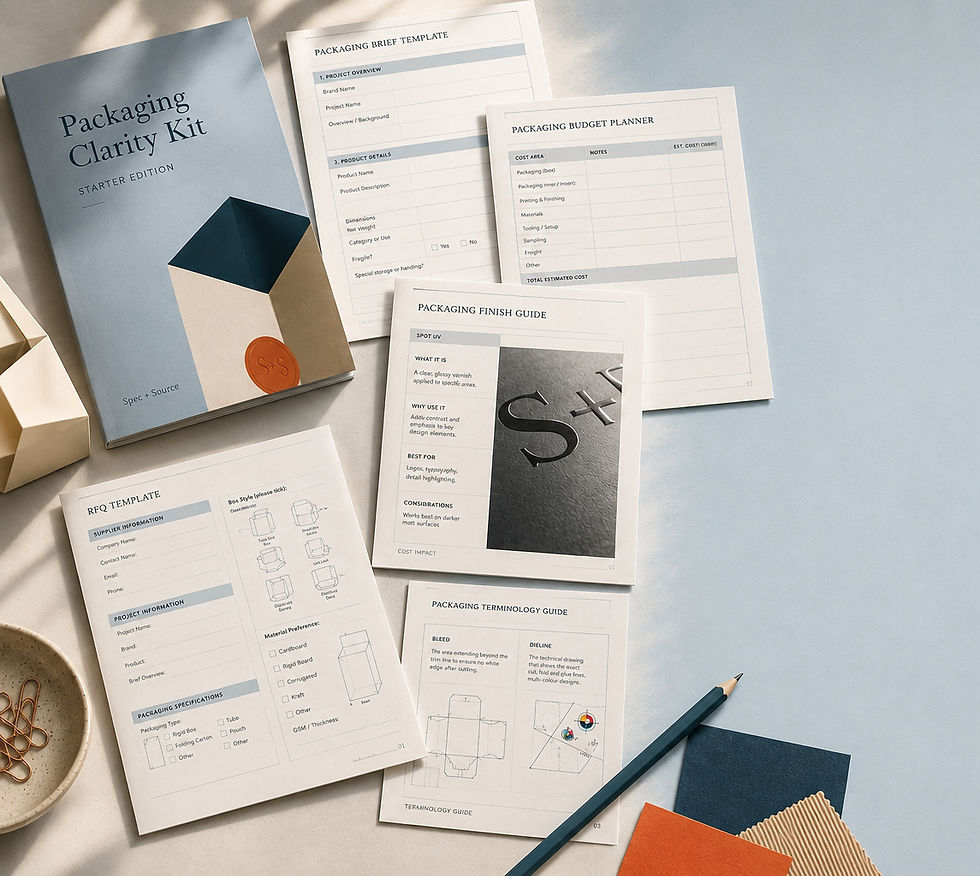
A supplier cannot accurately quote a pack without understanding what will go inside it.
Record the product’s:
Length, width and height
Weight
Shape
Fragile or vulnerable areas
Orientation inside the packaging
Additional components, accessories or literature
Be clear about whether the dimensions you provide are product dimensions, required internal packaging dimensions or final external dimensions. These are not interchangeable.
If the product requires an insert or fitment, consider how securely it needs to be held and whether it should be visible when the packaging is opened. A glass jar, for example, may need clearance around it as well as support at the base. A collection containing several products may require individually sized compartments.
You do not necessarily need a finished structural design before contacting a supplier. However, you should be able to explain the product, the preferred packaging format and the experience you want to create.
A good supplier can help refine the structure, but they need a clear starting point.
3. Understand your quantities and your variations
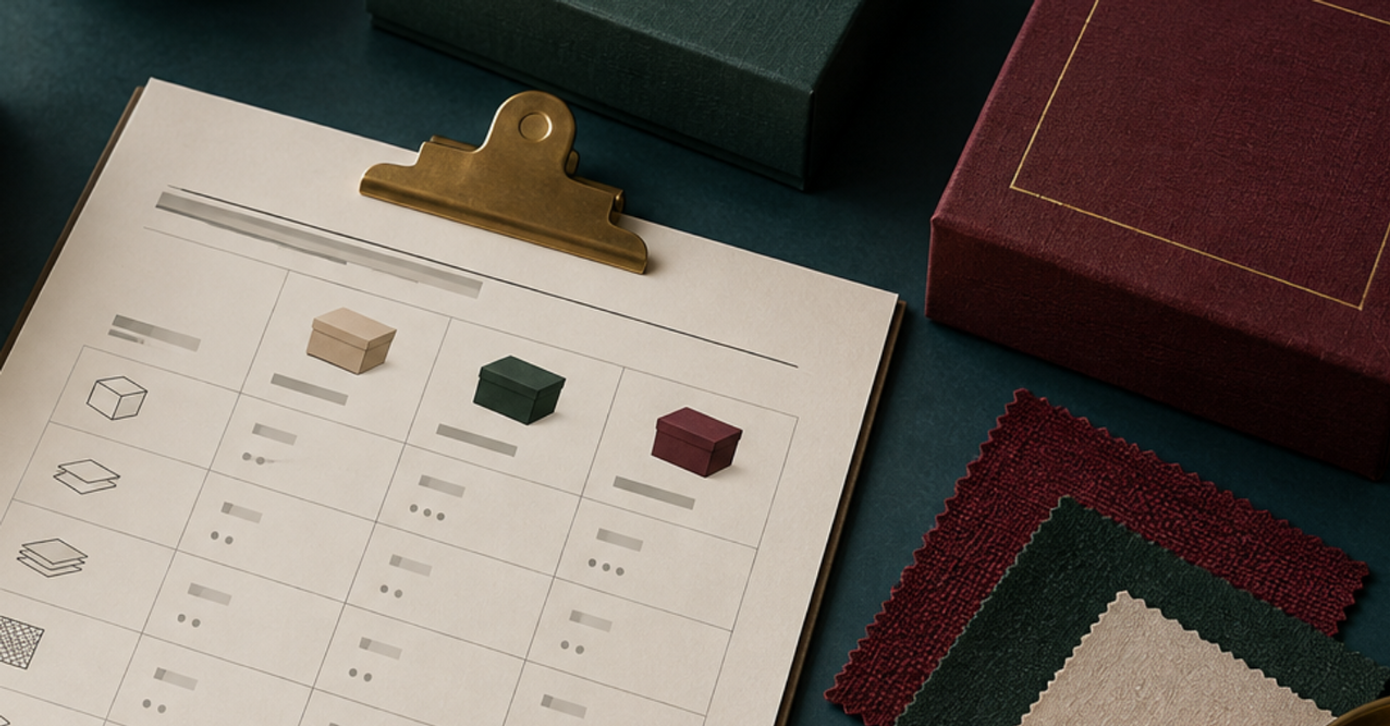
Quantity is one of the biggest influences on packaging price.
Packaging production normally includes setup work before the first usable pack is produced. Depending on the specification, this could include structural development, tooling, print setup, colour matching or finishing preparation. These costs are spread across the production quantity, which is why the unit price will often reduce as the volume increases.
When requesting a quote, provide:
Your initial order quantity
Your expected future order volume
The number of products or SKUs
Any differences in size, colour, artwork or finish
Whether the order could be repeated
Your preferred delivery schedule
Do not assume that the total number of packs will automatically be treated as one production quantity. If each SKU has different artwork, dimensions or materials, additional setup costs or minimum quantities may apply.
If you are launching several products, ask whether common components could be used across the range. Keeping the same box structure while changing a label, sleeve or printed insert may sometimes provide more flexibility than producing an entirely different pack for every product.
Be honest about your current volume. A clear conversation about quantities is far more productive than requesting a quotation based on an unrealistic future order.

4. Establish a realistic packaging budget
Many founders approach suppliers without a target budget because they do not yet know what packaging “should” cost.
That is understandable, but having at least a working budget range makes the sourcing process much more efficient.
Your budget helps determine whether the most suitable solution is likely to be a folding carton, rigid box, printed sleeve, stock component, bespoke structure or a combination of these.
When considering affordability, look beyond the headline unit price. Your total packaging cost may include:
Structural design or development
Samples and prototypes
Cutting tools or formes
Foiling, embossing or other finishing tools
Print setup or origination
Inserts and fitments
Assembly or packing
Freight and delivery
Import duties or customs costs
Storage
VAT
Ask suppliers to identify one-off costs separately from repeat production costs. This will help you understand what the first order will cost and what you are likely to pay when reordering.
If you genuinely do not have a budget, create a sensible ceiling based on your product price, margin and business model. Packaging should support the perceived value of the product without making the overall proposition commercially unworkable.
5. Separate your essentials from your preferences
A strong packaging brief distinguishes between what is essential and what is simply desirable.
Your non-negotiables might include:
A particular internal size
Protection during transit
A recyclable material
A specific launch date
Space for legally required information
A finish central to the brand identity
A maximum assembled size or weight
Your preferences might include:
A particular opening style
Foil rather than metallic ink
A coloured interior
A bespoke insert
A speciality paper
An additional printed sleeve
This distinction gives suppliers room to suggest alternatives without losing the purpose of the project.
For example, if a fully bespoke rigid box exceeds the available budget or minimum quantity, a supplier may be able to recommend a simpler construction, an existing stock size or a printed sleeve that achieves a similar effect.
The objective is not to remove ambition from the packaging. It is to understand which details create the most value and where you have flexibility.

6. Create one clear brief for every supplier
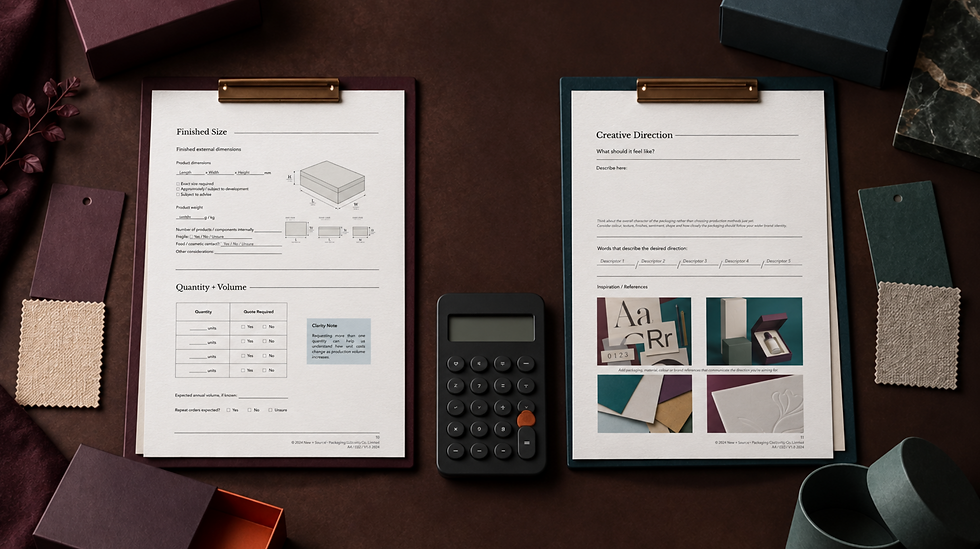
If each supplier receives different information, the resulting quotations will not be directly comparable.
Create one central packaging brief and send the same core requirements to everyone invited to quote.
This may sound obvious but even the slightest of variance with materials, finish or form can have a big impact on the costs.
Include:
Information about your brand and product
Product dimensions and weight
Preferred packaging style
Required quantity and number of SKUs
Materials or sustainability requirements
Print colours and artwork coverage
Finishes such as foil, embossing or spot UV
Insert or fitment requirements
Assembly expectations
Required delivery date
Delivery destination
Budget guidance, where appropriate
Ask each supplier to confirm exactly what is included and excluded.
You should also request a clear breakdown of:
Unit costs
Tooling and setup costs
Sampling charges
Production lead time
Delivery costs
Payment terms
Quote validity
Any assumptions used to calculate the price
Providing the same information does not guarantee that every supplier will propose exactly the same solution, but it gives you a far stronger basis for comparison.
It also reduces the repeated questions, revisions and delays that often arise from an incomplete initial enquiry.
7. Compare capability and suitability - not just price
The lowest unit price is not necessarily the best-value option.
Two quotations that appear to describe the same box may be based on different materials, board thicknesses, print processes, finishes, quantities, delivery terms or quality expectations.
Before appointing a supplier, consider:
Their experience with your packaging format
The quality of relevant samples
Their approach to sampling and approval
Communication and responsiveness
Production and delivery lead times
Quality-control processes
Material traceability and relevant certifications
Payment terms
Location and freight implications
Their ability to support future growth or repeat orders
What happens if something goes wrong
A slightly higher price may represent better materials, more thorough sampling, stronger quality control or a more dependable production schedule. Equally, an expensive quote is not automatically the best one.
The aim is to understand what you are paying for and whether the supplier is the right fit for your product, volume, budget and expectations.
Before you request a quote
Make sure you can answer these questions:
What is going inside the packaging?
What does the packaging need to protect or achieve?
What type of structure are you considering?
What are the product dimensions and weight?
How many packs do you need?
How many sizes, products or artwork variations are involved?
Which materials and finishes are essential?
Where will the finished packaging be delivered?
When do you need it?
What is your working budget?
What information do you need every supplier to include?
You do not need to have every production detail resolved before speaking to a packaging supplier. But arriving with a clear, considered brief will make the conversation more productive and the quotations far easier to evaluate.
Clarity at the beginning can prevent expensive misunderstandings later.
Ready to make your packaging brief clearer?
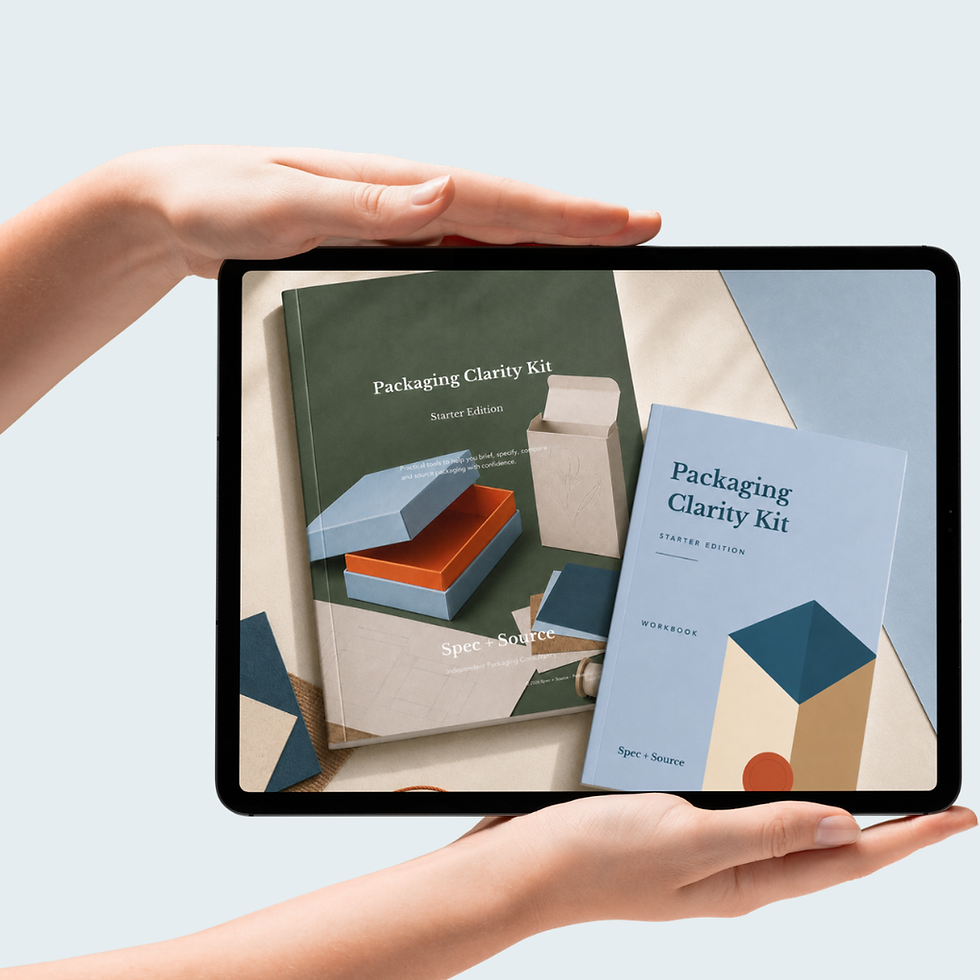
The Packaging Clarity Kit brings the planning process into one practical place, with templates for your packaging brief, request for quotation, budget, timeline and supplier comparison - plus guidance on terminology, materials and print finishes.
Use it to organise your requirements, approach suppliers with greater confidence and make more informed packaging decisions.

